
Process / Boiler Water Testing
Hardness, silica, alkalinity, conductivity and scaling/corrosion indices for boiler, cooling and process water.
About Process / Boiler Water Testing
Boiler, cooling and process water that drifts out of specification quietly destroys equipment — scaling robs heat transfer, corrosion eats tubes, and carry-over contaminates product. CVR Labs tests boiler feed, cooling-tower, DM and process water for the parameters that drive these failures: hardness, silica, alkalinity, phosphate, dissolved oxygen, conductivity and the Langelier/Ryznar scaling and corrosion indices.
Rather than a generic potability panel, this is a treatment-focused workup that tells your plant whether dosing is correct, whether blowdown is adequate, and whether the water is scaling or corrosive. Results support boiler safety, cooling-system efficiency and the process-water quality that protects product and uptime.
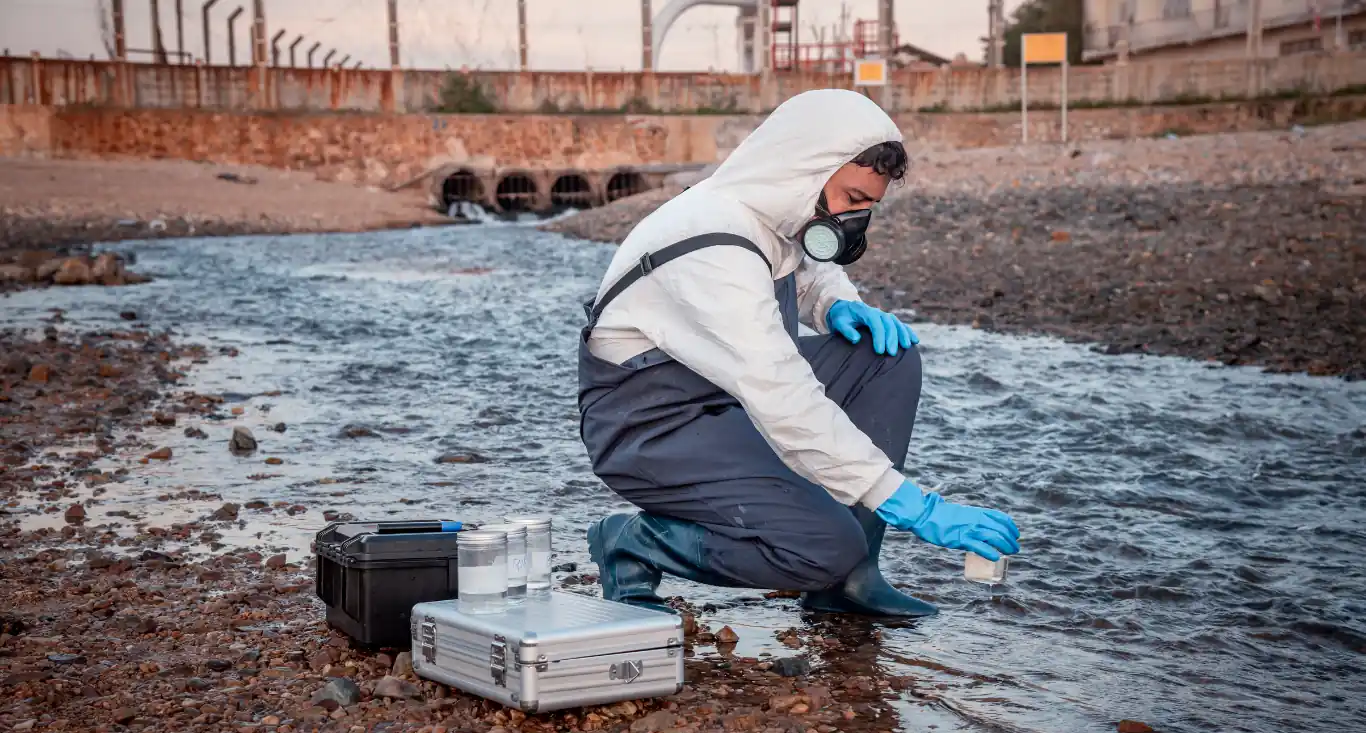
Signature tests under Process / Boiler Water Testing
The checks clients most often ask for with this service — we build the right sub-panel around your product and standard.
What we analyse under Process / Boiler Water Testing
The parameter groups below are drawn from this service's own accredited scope; the full searchable list follows.
Scaling kills heat transfer
Hardness and silica deposit as scale that insulates boiler and heat-exchanger surfaces, burning fuel and risking tube failure — caught early by water analysis.
Corrosion is silent and costly
Dissolved oxygen, low pH and aggressive indices corrode tubes and pipework from inside; monitoring keeps the treatment programme honest.
Carry-over contaminates product
Out-of-spec process water carries impurities into the product; specification testing protects both equipment and output.
Hardness, scale & silica
Alkalinity & treatment control
Corrosion indicators
Solids, oxygen demand & ions
Process / Boiler Water Testing — parameters & methods
| Parameter / Test | Method / Standard |
|---|---|
| Acidity as CaCO3 | 2310B APHA 24th EditionIS 3025 (Part 22) |
| Ammonia | 4500-NH3 C APHA 24th EditionIS 3025 (Part 34/Sec- 1)CVR/WT/SOP/019 |
| Anionic Detergents as MBAS | 5540 C APHA 24th EditionIS 3025 (Part 68)IS 3025(Part 68) |
| Appearance | 2110 APHA 24th Edition |
| Bicarbonates as HCO3 | 2320 B APHA 24th Edition |
| Bio Chemical Oxygen Demand (3 days @ 27° C) | IS 3025 (Part 44) |
| Bio Chemical Oxygen Demand (5 days @ 20° C) | 5210 B APHA 24th Edition |
| Calcium as Ca | 3500-Ca B APHA 24th EditionIS 3025 (Part 40)IS 7224 |
| Calcium Hardness (as CaCO3) | 3500 Ca B APHA 24th Edition |
| Carbonate Hardness as CaCO3 | IS 3025 (Part 21)IS 3025 (Part 21)) |
| Carbonates as CO3 | 2320 B APHA 24th Edition |
| Chemical Oxygen Demand | IS 3025 (Part 58)5220 B APHA 24th Edition |
| Chloramines as Cl2 | 4500-Cl G APHA 24th EditionIS 3025 (Part 26) |
| Chloride (as Cl) | IS 3025 (Part 32) Argentometric Method4500-Cl- B APHA 24th Edition4500-Cl - B APHA 24th Edition |
| Colloidal Silica | CVR/WT/SOP/35 |
| Colour | 2120 B APHA 24th EditionIS 3025 (Part 4) Platinum Cobalt (Visual Comparison Method)2120 B APHA24th Edition |
| Conductivity @ 25°C | IS 3025 (Part 14)2510 APHA 24th Edition2510 B APHA 24th Edition |
| Cyanide (as CN) | 4500-CN- E APHA 24th EditionIS 3025 (Part 27/Sec- 1)IS 3025 (Part 27/Sec 1) |
| Dissolved Oxygen | IS 3025 (Part 38)4500-O APHA 24th Edition |
| Ferrous Iron as Fe | 3500-Fe B APHA 24th Edition3500-Fe B APHA24th Edition |
| Fluoride (as F) | 4500-F- D APHA 24th EditionIS 3025 (Part 60/Sec- 1)IS 3025 (Part 60/Sec 1) |
| Free CO2 | 4500-CO2 C APHA 24th Edition |
| Free residual chlorine | 4500-Cl B APHA 24th EditionIS 3025 (Part 26) |
| Hexavalent Chromium as Cr6+ | 3500-Cr B APHA 24th EditionIS 3025 (Part 52) |
| Iron as Fe | 3500-Fe B APHA 24th EditionIS 3025 (Part 53)CVR/INS/SOP/ICPMS/005 |
| Magnesium as Mg | IS 3025 (Part 46)3500-Mg B APHA 24th EditionIS 7224 |
| Magnesium Hardness (as CaCO3) | 3500 Mg B APHA 24th Edition |
| Methyl Orange Alkalinity as CaCO3 | 2320 B APHA 24th EditionIS 3025 (Part 23) |
| Nitrate as NO3 | IS 3025 (Part 34/Sec- 1) Clause 6.44500-NO3-B APHA 24th EditionIS 3025 (Part 34/Sec 1) Clause6.4 |
| Nitrite as NO2 | IS 3025 (Part 34/Sec- 1)4500-NO2 B APHA 24th EditionIS 3025 (Part 34/Sec 1) |
| Non carbonate Hardness as CaCO3 | IS 3025 (Part 21) |
| Odour | 2150 APHA 24th EditionIS 3025 (Part 5)IS 3025:Part 5 |
| Oil and Grease | 5520 B APHA 24th EditionIS 3025 (Part 39) |
| Oxygen absorbed in 4 hours | IS 3025 (Part 63) |
| Percent Sodium | CVR/WT/SOP/39CVR/WT/SOP/013 |
| pH @ 25°C | IS 3025 (Part 11)4500 H+-B APHA 24th Edition4500-H+ B APHA 24th Edition |
| Phenolic Compounds (as C6H5OH) | 5530 C APHA 24th EditionIS 3025 (Part 43/Sec- 1) Clause 6IS 3025 (Part 43/Sec 1) Clause 6 |
| Phenolphthalein Alkalinity as CaCO3 | 2320 B APHA 24th EditionIS 3025 (Part 23) |
| Phosphate (as PO4) | 4500-P D APHA 24th EditionIS 3025 (Part 31/Sec- 1) Clause 5IS 3025 (Part 31/Sec 1) Clause 5 |
| Potassium as K | 3500-K B APHA 24th EditionIS 3025 (Part 45) Clause 5CVR/WT/SOP/021 |
| Reactive Silica as SiO2 | 4500-SiO2 D APHA 24th Edition |
| Sodium Absorption Ratio | IS 11624 |
| Sodium as Na | 3500-Na B APHA 24th EditionIS 3025 (Part 45) Clause 5CVR/WT/SOP/021 |
| Sulphate (as SO4) | IS 3025 (Part 24/Sec- 1) (TURBIDITY METHOD)4500-SO42- E APHA 24th Edition4500-SO4 E APHA 24th Edition |
| Sulphide (as H2S) | 4500-S2- D APHA 24th EditionIS 3025 (Part 29)4500-S2- D APHA 4th Edition |
| Sulphite (as SO3) | 4500-SO3 B APHA 24th Edition |
| Taste | 2160 C APHA 24th EditionIS 3025 (Part 8) |
| Total Alkalinity as CaCO3 | 2320 B APHA 24th EditionIS 3025 (Part 23) |
| Total Dissolved Solids at 180 °C | IS 3025 (Part 16)2540 C APHA 24th Edition2540C-APHA 24th Edition |
| Total Hardness as CaCO3 | 2340 C APHA 24th EditionIS 3025 (Part 21) EDTA Method |
| Total silica as SiO2 | 4500 SiO2 D APHA 24th EditionIS 3025 (Part-35)IS 3025 (Part-35) Clause 7 |
| Total solids at 105°C | 2540 B APHA 24th EditionIS 3025 (Part 15) |
| Total Suspended Solids @ 105°C | 2540 D APHA 24th EditionIS 3025 (Part 17) |
| Turbidity | IS 3025 (Part 10)2130 B APHA 24th Edition |
How Process / Boiler Water Testing is tested
Reference methods applied
Hardness, alkalinity, silica, phosphate, dissolved oxygen and the supporting ions are determined by the IS 3025 series and APHA Standard Methods (titrimetric, spectrophotometric and electrometric), with iron by ICP-MS where trace levels are required. The Langelier and Ryznar indices are derived from the measured hardness, alkalinity, pH, TDS and temperature. Where more than one standard applies, the appropriate method is selected for each sample.
Accreditations covering Process / Boiler Water Testing
See the Accreditations & Scope page for full certificate details.
Samples we accept for Process / Boiler Water Testing
From enquiry to accredited report
Request a Quote
Share product, parameters and target standard.
Send Sample
Submit in sealed, labelled packaging or arrange pickup.
Login & Prep
Logged in LIMS with unique IDs and prepared.
Accredited Analysis
Validated NABL-scope methods on advanced instruments.
Test Report
Traceable, accredited report with limit comparison.
Process / Boiler Water Testing — frequently asked questions
Is Process / Boiler Water Testing NABL-accredited at CVR Labs?
How is this different from drinking-water testing?
Can you tell me if my water is scaling or corrosive?
What samples do boiler programmes need?
What samples do you accept for Process / Boiler Water Testing?
What parameters are included in Process / Boiler Water Testing?
Ready to test with an accredited laboratory?
NABL ISO/IEC 17025:2017 · ISO 9001 · ISO 45001 · CPCB · BIS — trusted since 1999.